Serving Kennesaw, GA and Surrounding Areas



How to Troubleshoot Water Heater Issues in Marietta
Proudly Rated on Google with Reviews
Call Us Anytime: We offer Live 24/7 Answering!

When your water heater starts acting up, it’s rarely a total mystery. Most problems give you clues before they get serious. The trick is knowing what to look for and what it actually means. Integrated Plumbing Solutions has been helping Marietta homeowners diagnose and fix water heater problems since 2012, and a big part of that job is helping people understand what’s happening before they assume the worst.
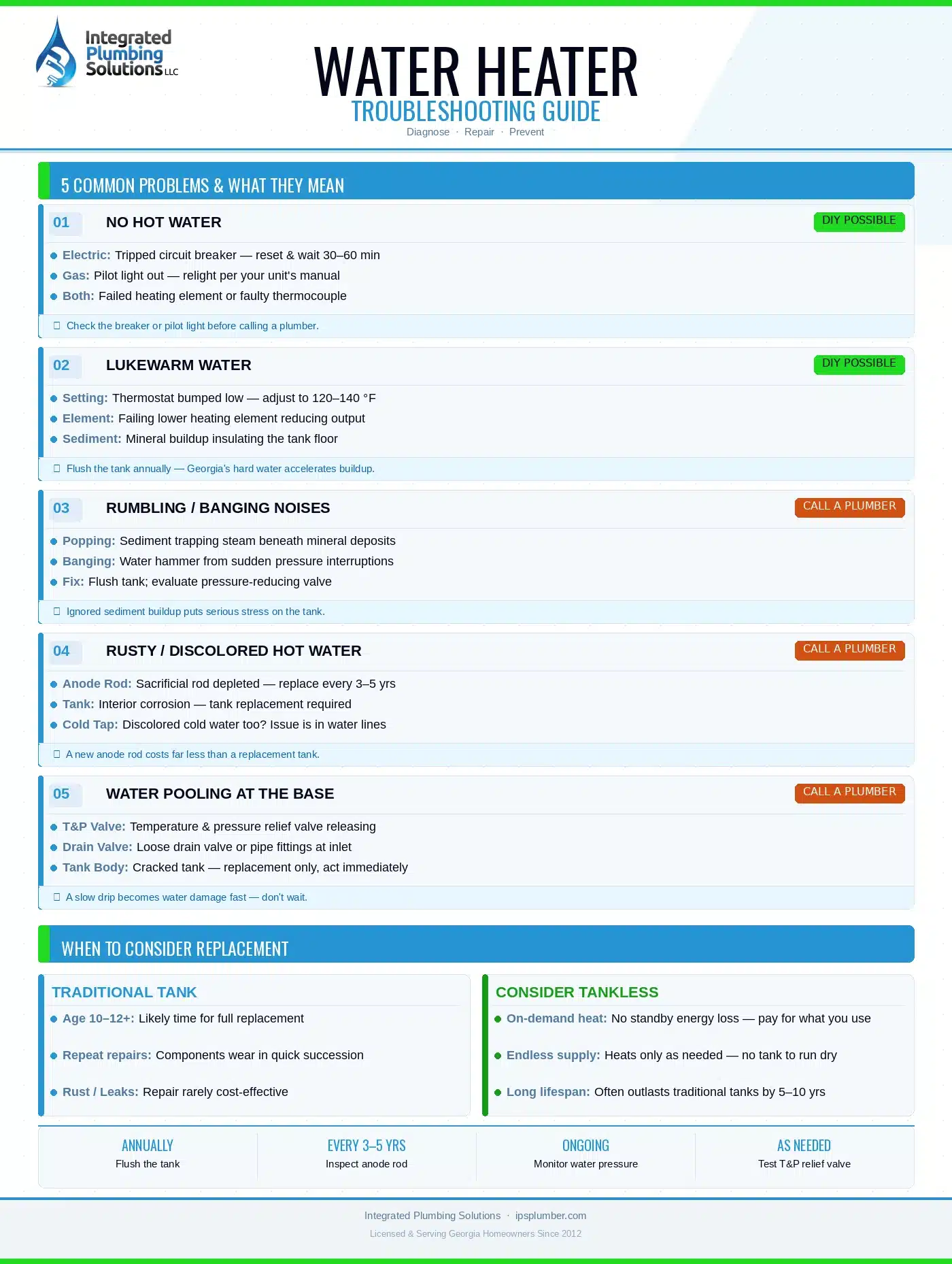
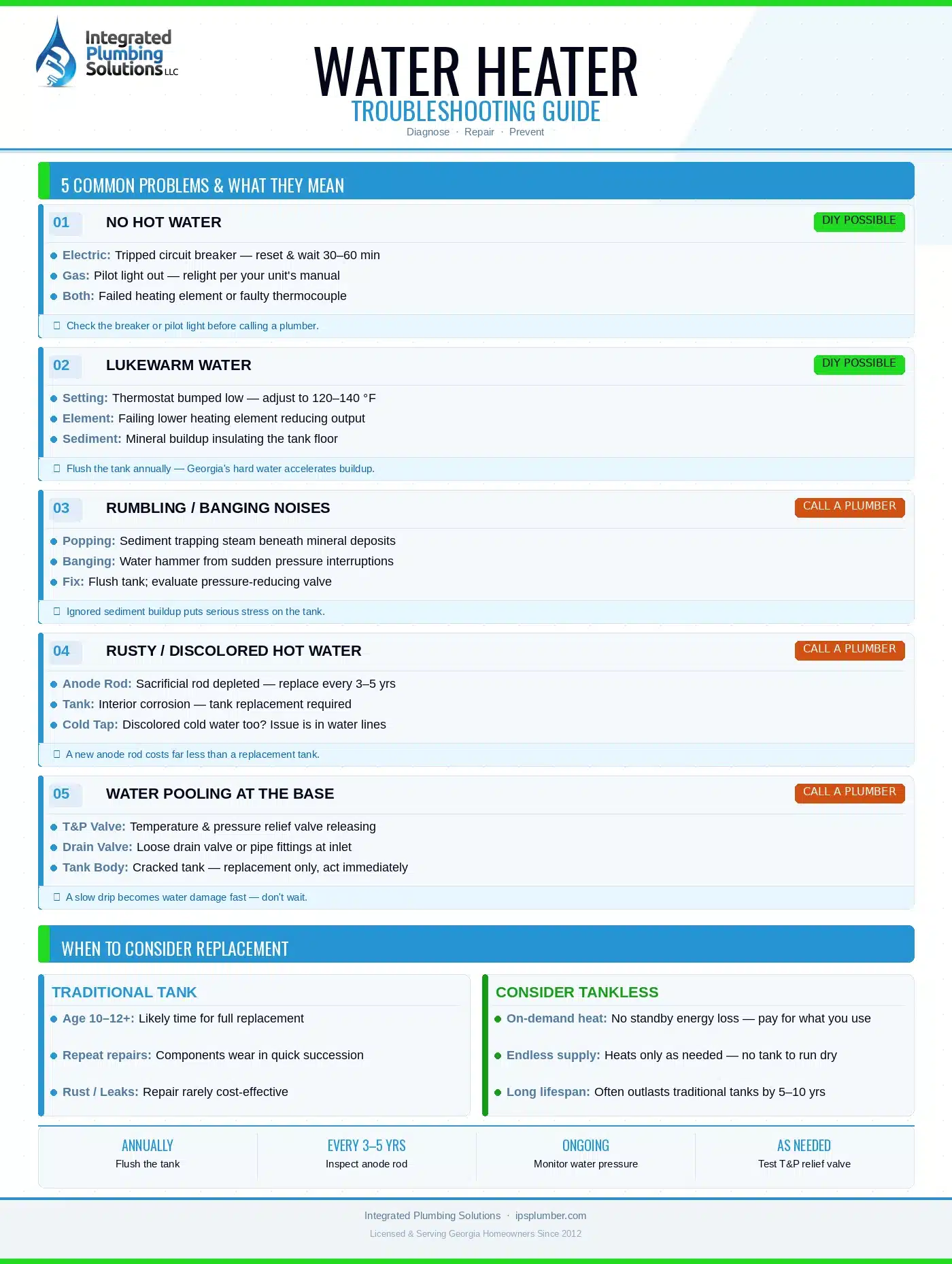
This guide walks you through the most common water heater symptoms, what’s likely causing them, and when you can handle it yourself versus when you need a licensed plumber.
[phone_button]
The Water’s Gone Completely Cold
This is the one that sends people into full panic mode, but it’s often fixable without a service call.
If you have an electric water heater, start with the circuit breaker. A tripped breaker is one of the most common culprits. Reset it and give the unit 30 to 60 minutes to reheat before assuming there’s a deeper problem.
For gas water heaters, check whether the pilot light is out. Most modern units have an electronic ignition, but if yours has a standing pilot, it can go out from a draft or gas supply interruption. Your unit’s manual will walk you through relighting it.
If neither of those is the issue, you could be dealing with a failed heating element (electric) or a faulty thermocouple (gas). Both are repairable, but at that point it’s worth having a plumber take a look rather than guessing at parts.
You’re Getting Lukewarm Water Instead of Hot
Getting some hot water but not enough? A few things could be going on.
First, check your thermostat setting. Most water heaters are factory-set between 120°F and 140°F. If it got bumped down somehow, that’s an easy fix. If the setting is fine but you’re still getting lukewarm water, a failing heating element or a buildup of sediment at the bottom of the tank is likely slowing heat transfer.
Sediment accumulation is especially common in Marietta and the surrounding areas because of Georgia’s moderately hard water. Over time, minerals settle at the bottom of the tank and form a layer that the heating element has to work through. That’s inefficient, and it puts extra stress on the unit. Regular water heater maintenance including flushing the tank annually goes a long way toward preventing this.
That Rumbling or Banging Noise Is Trying to Tell You Something
That noise isn’t your imagination. Popping and rumbling sounds almost always point to sediment buildup. As water heats up and tries to move through the layer of mineral deposits, it creates those sounds. It’s not dangerous on its own, but it signals that your tank needs to be flushed and that the issue will get worse if ignored.
A banging sound can also indicate water hammer, a pressure surge in your pipes when water flow is suddenly interrupted. If that’s happening, it’s worth checking your home’s water pressure and whether a pressure-reducing valve might be needed.
Rust-Colored Water Coming From the Hot Tap
Rusty or brownish water coming from your hot tap usually means one of two things: the interior of your tank is corroding, or the sacrificial anode rod (the component inside the tank that prevents corrosion) is depleted and needs to be replaced.
The anode rod is essentially a wear part. It’s designed to corrode so your tank doesn’t. Most rods last 3 to 5 years depending on water quality. If yours is overdue, replacing it is far cheaper than replacing the whole tank. If the tank itself is already corroded, repair isn’t really an option. That’s a replacement conversation.
If you’re also noticing discoloration from cold water taps, the issue may be with your home’s water lines rather than the water heater itself.
There’s Water Pooling Around the Base of the Unit
A small puddle near the base of your water heater warrants attention, but it doesn’t automatically mean disaster.
Common leak sources include the temperature and pressure (T&P) relief valve, the drain valve, or loose pipe fittings. These are often fixable. What isn’t fixable is a crack or rupture in the tank itself. If the tank is leaking from the body, replacement is the only path forward.
Don’t ignore a leak and hope it resolves itself. Water damage accumulates fast, and what starts as a drip can escalate quickly. If you’re not sure where it’s coming from, call for water heater repair before the situation gets worse.
When Troubleshooting Points to Something Bigger
Sometimes you work through the checklist and realize the problem isn’t a simple fix. If your unit is more than 10 to 12 years old and you’re running into repeated issues, the calculus often shifts from repair to replace. At that age, components are wearing out in sequence, and you can spend a lot keeping an older unit alive.
That’s also a good time to think about whether a tankless water heater makes sense for your home. Tankless systems heat water on demand rather than storing it, which eliminates standby energy loss and gives you an effectively unlimited supply of hot water. They’re not the right fit for every home, but they’re worth understanding before you commit to another traditional tank.
Still Not Sure What’s Wrong? Let’s Figure It Out.
If you’ve worked through these steps and still aren’t sure what’s going on, or if you’re dealing with a gas-related issue, an active leak, or anything that feels beyond a DIY fix, don’t sit on it. Reach out to Integrated Plumbing Solutions to schedule a visit. Their team can accurately diagnose the problem and walk you through your options, giving you a straight answer about what your water heater actually needs.
[phone_button]

We Have The Expert Solutions for Your Plumbing Problems
Many plumbing issues are connected to problems elsewhere in the system. Integrated Plumbing Solutions takes a broader approach, helping homeowners address concerns involving drains, sewer lines, water lines, septic systems, and water heaters before they lead to larger repairs.